The Product Marketing House Model: A 4-Layer Framework for B2B Positioning
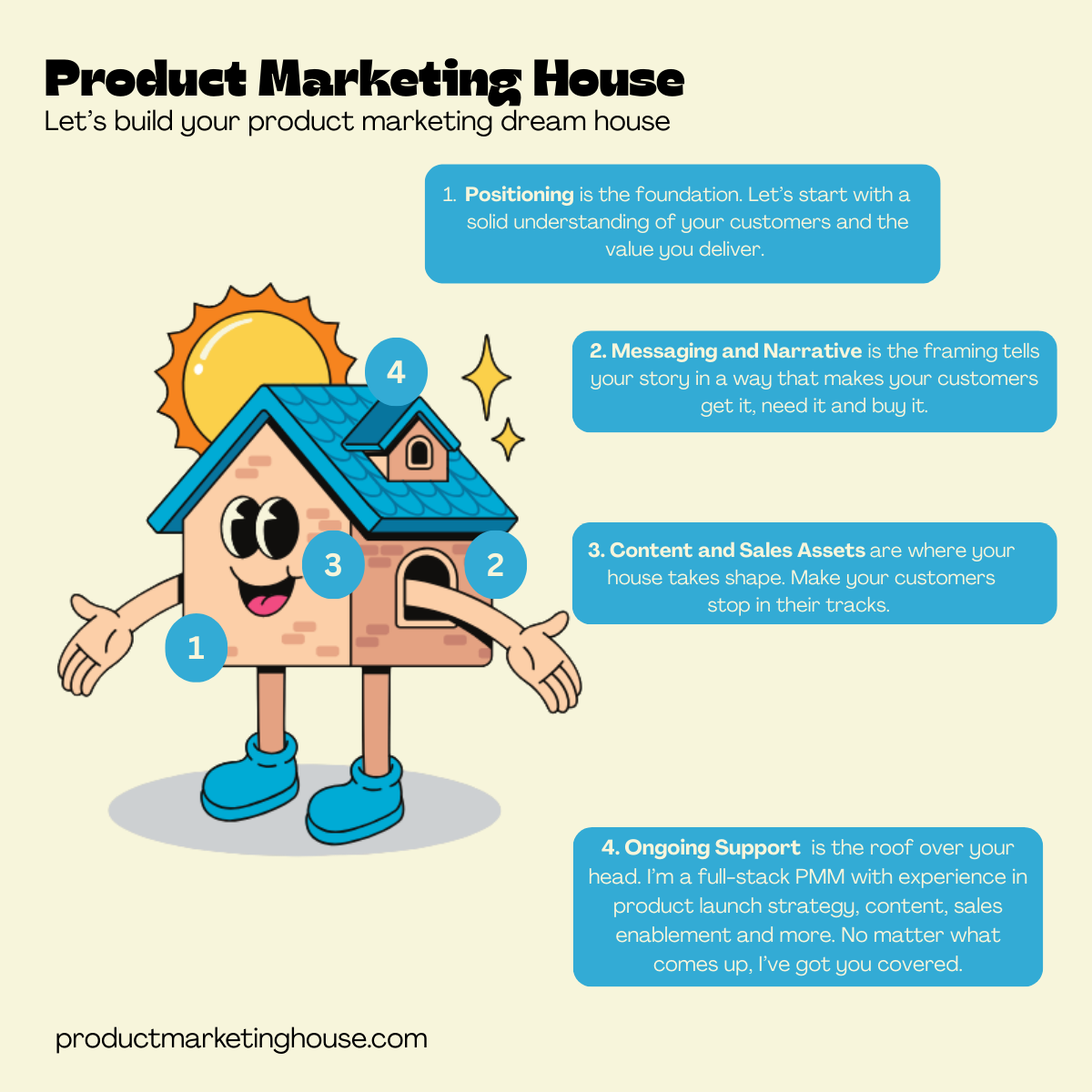
The Product Marketing House Model is a four-layer B2B product marketing framework: positioning (the foundation), messaging and narrative (the framing), content and sales assets (the furnishing), and ongoing support (the roof). I created the model to give startups a clear build order for product marketing, starting with positioning so every message, asset and launch rests on a solid base.
Key takeaways
Build product marketing in order: positioning, then messaging, then assets, then ongoing support.
Positioning is the foundation. Skip it and every deck, page and launch eventually cracks.
Messaging makes your positioning public. Pillars are the walls, value propositions are the windows, and audience messaging is the door each buyer walks through.
Each layer only needs to be “solid enough” to build on, not perfect.
Already have assets but shaky positioning? Fix the foundation first, even if it feels like going backwards.
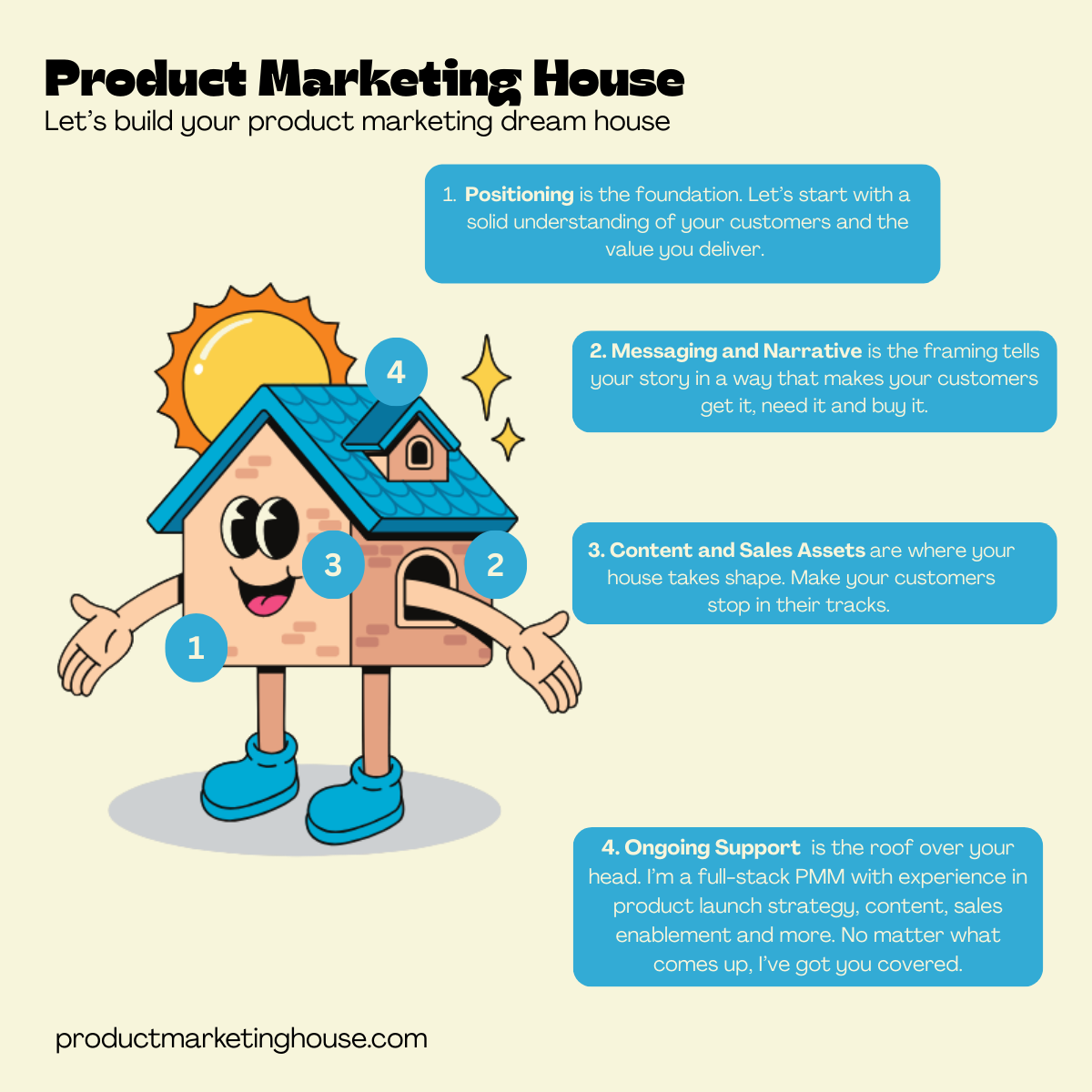
Why a house?
I came up with the Product Marketing House to explain to CEOs how product marketing actually works. I kept hearing the same requests: “Can’t you just start with the website?” or “We need sales decks first, and we’ll figure out positioning later.”
That’s like asking to put up the walls and worry about the foundation later. You can try. But when the ground shifts, and it always shifts, everything you built starts to creak.
I’ve watched it happen. One Series B startup I worked with had gorgeous sales decks, beautiful website copy and a content calendar any marketer would envy. Then a new competitor showed up, the market moved and an executive left. Suddenly sales couldn’t explain why customers should choose them, campaigns stopped converting, and a simple change to the sales deck took months. They had furnished a house they never built.
The house model fixes that by giving you a build order. It also gives you a polite way to turn down requests to install chandeliers before anyone has poured concrete.
Layer 1: Positioning, the foundation
Positioning is the shared understanding of who you serve, what value you deliver, what makes you different and why anyone should care. You can’t build a house on sand. Every asset you create later pulls from this layer.
The foundation has three parts:
Your PMM definition. This is internal positioning: what product marketing means at your company, your top three to five priorities, and what you won’t take on yet. Without it, product marketing becomes the “everything else” team.
Customer insights. Positioning has to rest on real customer understanding, not internal assumptions. That means interviews (at least three to five customers, ideally five to ten) plus a habit of listening to customers regularly.
Your positioning framework. This is where it comes together: your best-fit customers, competitive alternatives, unique value and market category. I build it with April Dunford’s positioning method and test it against what customers actually say.
Your foundation is solid enough when:
You can say clearly who you’re for, and who you’re not for
You can explain your differentiation in a way customers understand
Your leadership team generally agrees on the positioning
You’ve tested it with real customers
It actually helps you make decisions
Layer 2: Messaging and narrative, the framing
Messaging is positioning made public. Positioning is the architect’s plan. Messaging is the house built from that plan, and it shapes everything on your website, in your sales deck and in the email a rep sends on a Tuesday afternoon.
The framing has three parts:
The walls: three to four core messaging pillars. These are the main value themes everything connects to. More than four usually means you haven’t decided what matters most.
The windows: value propositions. For each pillar, describe the customer’s problem, how you solve it and the result they get, in their words.
The doors: audience-specific messaging. A VP of Sales and a CFO walk in through different doors to the same house. Keep the core story the same and change which window you open first.
The strategic narrative is the load-bearing structure that holds the framing together. It tells the story of the change happening in your market and why your product fits it, and it gives sales a story they actually want to tell.
The six principles of strong framing:
Pick one key deliverable to anchor your messaging, usually the sales deck or homepage.
Write for a specific customer, using the words customers actually say.
Lead with value. Features are the proof, not the point.
Cut jargon, while keeping the industry vocabulary your buyers expect.
Write simply enough for a seventh-grade reader.
Back every claim with proof: a customer quote, a metric or a result.
Layer 3: Content and sales assets, the furnishing
The furnishing is where your strategy turns into things your team can use every day. That covers your website, sales deck, one-pagers, case studies, battlecards and launch materials. This is the layer most companies start with, and the reason so many of them start over.
Built on a solid foundation and framing, this layer goes fast. A sales deck takes an afternoon instead of a week because the story is already decided. This layer covers:
A repeatable go-to-market and launch process, with launch tiers and clear owners
Sales enablement: decks, talk tracks, battlecards and objection handling
Website messaging and the core content that puts your story in front of buyers
Customer case studies that prove your messaging pillars
Layer 4: Ongoing support, the roof
The roof protects everything you’ve built. Markets move, competitors launch and new executives want to “simplify the story.” Ongoing support keeps your house standing through all of it. This layer covers:
Measurement that connects product marketing to win rates, adoption and pipeline
A 90-day plan and regular check-ins with sales, product and leadership
Quarterly reviews of your positioning and messaging
Team building, including when and how to hire your first full-time PMM
Loading your positioning and messaging into your company’s internal AI tools, so every AI-written email, deck and post stays on message
The building code: five rules for every PMM house
Talk to real customers. Positioning built only on internal assumptions won’t hold up for long.
Get stakeholder buy-in early. Bring in your boss, sales and product leaders while you build, not after.
Make it tangible. Document the work where people can find it, then show them how to use it.
Connect it to business goals. Tie every layer to a real company goal or metric.
Use it or lose it. Make at least one real decision with your positioning right after you build it.
What does your product marketing house look like today?
Most teams fall into one of four stages:
Empty lot: Positioning was never defined, and everyone describes the product differently. Good news: you have nothing to tear down.
Startup shack: Something is standing, but the foundation has cracks. Assets get rebuilt from scratch, and launches are chaotic.
Mid-renovation: Good bones. Positioning exists but needs testing, and messaging takes too much work to adapt.
Move-in ready: Positioning is clear and customer-tested, messaging is documented, and sales uses it without being asked.
Renovating? Fix the foundation first, even if it feels like going backwards. Patching cracks and building upward costs far more six months from now.
Frequently asked questions
What is the Product Marketing House Model?
The Product Marketing House Model is a four-layer B2B product marketing framework created by Megan Pratt. It builds product marketing in order: positioning (foundation), messaging and narrative (framing), content and sales assets (furnishing), and ongoing support (roof). Each layer rests on the one below it.
Who created the Product Marketing House Model?
Megan Pratt, founder of Product Marketing House, created it. She developed the model while working as the first head of product marketing at high-growth startups, including Alyce and Encamp, to show CEOs why positioning has to come before websites and sales decks.
Why does positioning come first?
Positioning decides who you serve, what value you deliver and why you’re different. Every message and asset depends on those answers. Without them, teams rebuild decks from scratch, sales tells different stories, and launches fall flat when the market shifts.
What’s the difference between positioning and messaging?
Positioning is internal strategy: who the product is for, what it’s compared to and why it wins. Messaging is that strategy made public in words customers see. In the house model, positioning is the architect’s plan and messaging is the framing built from it.
How long does it take to build a product marketing house?
An in-house PMM can build the first version of all four layers in about 30 days alongside their regular work, using the Product Marketing House workbook. With a fractional product marketing leader, most startups have agreed positioning within the first month.
Can I skip a layer?
You can, but it rarely holds. Teams that start with assets usually come back to fix positioning later, often after a costly launch or website rebuild. If your house is already partly built, strengthen the weakest layer first and keep building upward.
Who is the Product Marketing House Model for?
It’s for B2B tech startups and the people who build their product marketing: first-time heads of product marketing, solo PMMs, generalist marketing leaders and founders. It works for new construction and for teams renovating messaging that already exists.
Build your house with Megan
I’m Megan Pratt, a fractional product marketing leader for B2B tech startups. I’ve built product marketing from scratch as the first head of PMM at multiple startups, and Product Marketing Alliance named me one of the Top Product Marketing Consultants of 2025.